
Photo of Robert Horton

As chair of the firm’s Labor & Employment Practice Group, Bob Horton represents management in all areas of labor and employment law. Bob’s practice consists primarily of counseling clients regarding employment issues and defending companies against all manner of employment claims throughout the U.S.

In an article published by the Nashville Business Journal, we urge employers to get ready for the U.S. Equal Employment Opportunity Commission’s data reporting. Although facing criticism, the U.S. Equal Employment Opportunity Commission (EEOC) is moving forward with its pay data collection, and with the reporting deadline set for September 30, employers should prepare now.

Employers with more than 100 employees and any federal contractors with more with 50 employees are required to submit an EEO-1 survey, which has historically analyzed organizations’ employment data categorized by sex, race and ethnicity. Under the new reporting requirements, employers and federal contractors with more than 100 employees will also report compensation data.Continue Reading What Employers Need to Know about EEOC’s Pay Data Collection Plan
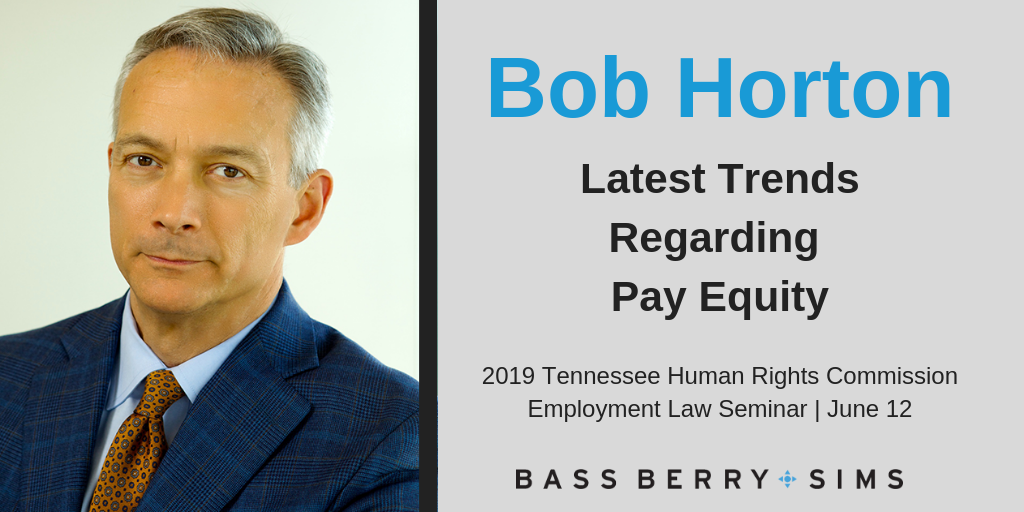
Bob Horton will be presenting on recent pay equity trends at the Tennessee Human Rights Commission’s (THRC) 2019 Employment Law Seminar.I am looking forward to presenting on recent pay equity trends at the Tennessee Human Rights Commission’s (THRC) 2019 Employment Law Seminar.

The seminar will be held at the One Century Place Conference Center in Nashville on Wednesday, June 12, 2019 from 8:00 a.m. – 3:30 p.m. CST.

For more information and to register, visit

The Supreme Court ruled on April 24, 2019 that an arbitration agreement which is ambiguous as to whether the parties had agreed to class arbitration was insufficient to require a party to participate in class arbitration.

In the 2011 case Stolt-Nielsen S.A. v. Animal Feeds Int’l Corp., 559 U.S. 662 (2011) the Supreme Court decided that “silence” in an arbitration agreement regarding the issue of class arbitration meant that a party could not be compelled to engage in class arbitration.  In the more recent case of Lamps Plus, Inc. v. Varela, an employee had sought to compel his employer to arbitrate on a class basis claims arising out of the release of personal data belonging to its employees.Continue Reading Supreme Court Rules on Enforcement of Class Arbitration

The recent Sixth Circuit opinion in Hostettler v. The College of Wooster, No. 17-3406 (6th Cir. July 17, 2018), is a cautionary tale for employers faced with a full-time employee seeking a modified work schedule as an accommodation for a disability under the Americans with Disabilities Act (ADA).

An HR Generalist for the College, Hostettler was unable to return to work full time after the conclusion of her 12 weeks of maternity leave because of postpartum depression and separation anxiety.  The district court granted summary judgment to the College, finding that full-time work was an essential function of the position and that Hostettler was not a qualified individual under the ADA because she could not perform that essential function.Continue Reading Is a Reduced Work Schedule for a Full-Time Employee a Reasonable Accommodation?

I authored an article for Modern Restaurant Management magazine outlining the Supreme Court’s recent decision impacting the future of class action waivers in arbitration agreements. In May 2018 the Supreme Court issued a decision in three consolidate cases NLRB v. Murphy Oil USA Inc.Epic Systems Corp. v. Lewis, and Ernst & Young LLP v. Morris ruling that “an employer may require an employee, as a condition of employment, to enter into an arbitration agreement in which the employee agrees to waive the right to bring a class or collective action.”
Continue Reading The Future of Class Action Waivers in Arbitration Agreements

Bass, Berry & Sims attorneys Bob Horton and Kimberly Veirs contributed an article for Practical Law on Tennessee laws related to the mutual agreements to arbitrate employment-related disputes. The article outlines key differences between federal and Tennessee arbitration law and cites several cases interpreting these statutes. Bob and Kimberly also provided sample language for a Tennessee-specific agreement to arbitrate employment-related claims that can be used by employers with employees in Tennessee.
Continue Reading Mutual Agreement to Arbitrate Employment-Related Disputes (TN)

Bass, Berry & Sims attorneys Bob Horton and Kimberly Veirs contributed an article for Practical Law on Tennessee laws related to the mandatory arbitration of employment-related claims. The article outlines key differences between federal and Tennessee arbitration law and provides guidance on issues associated with unconscionability, severability, waiver of class and representative actions, arbitrability, drafting considerations, EEOC challenges, and bracketed text. As part of the article, the authors provided sample language for a Tennessee compliant mandatory arbitration provision of employment-related claims that can be incorporated into a written employment agreement or employee handbook.
Continue Reading Mandatory Arbitration of Employment-Related Claims (TN)

In an article published by the Society for Human Resource Management (SHRM), Bass, Berry & Sims attorney Bob Horton provided insight on what responsibilities franchisors have for ensuring that franchisees comply with employment laws. Bob suggests that “simply providing training to franchisees regarding employment law should not transform, by itself, a franchisor into an employer.

Some employers require all, or most, of their employees to sign a non-competition agreement, rationalizing that even if not enforceable, at least the non-competition agreement will make the employee “think twice” before leaving, especially to a competitor.  This practice has come under attack recently as anti-competitive.
Continue Reading Non-Competition Agreements Under Fire: Who Should be Required to Sign?